| Tweet |
Radio Shack TRS-80 Model 1
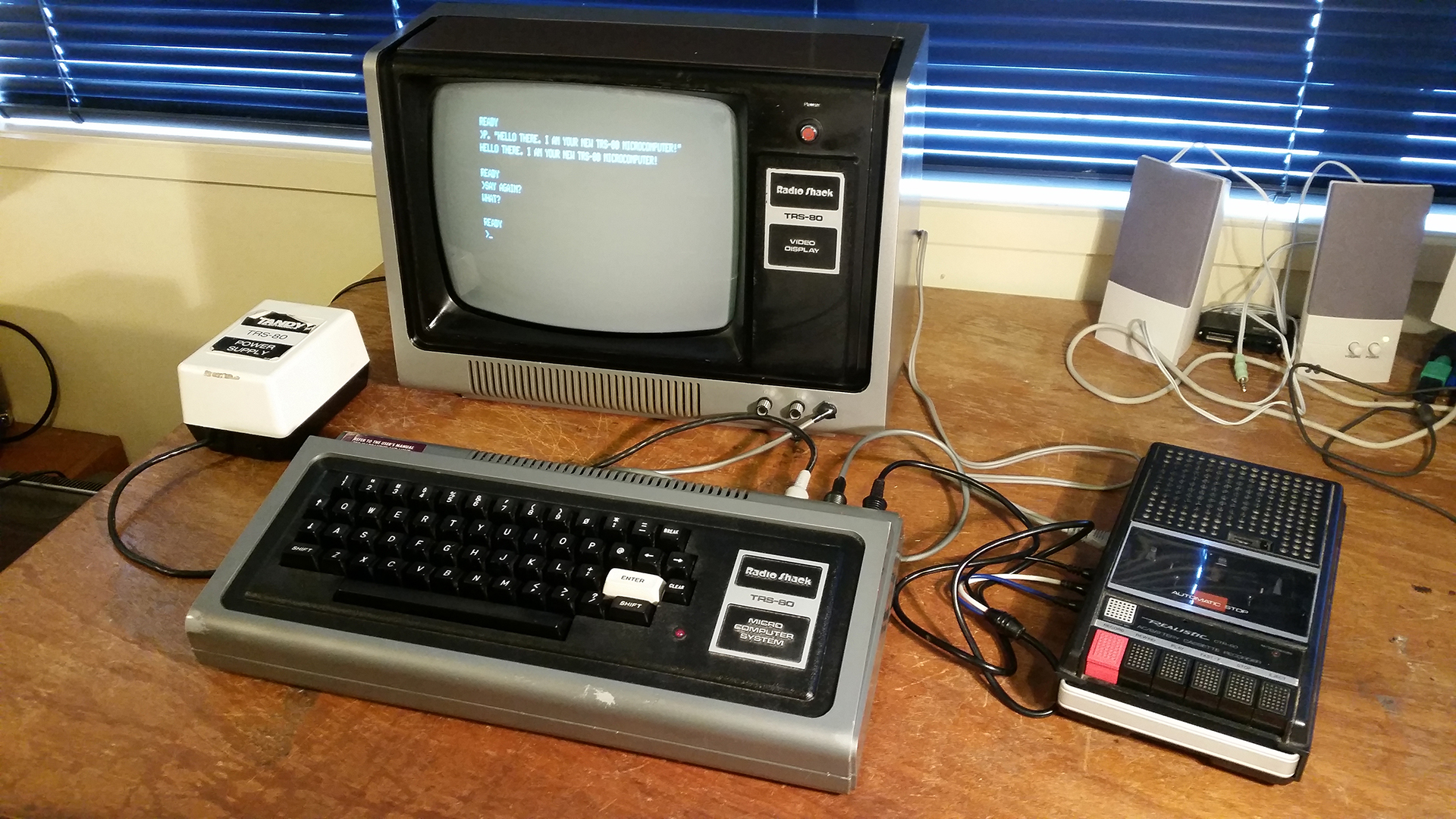 (Note: Click the images for larger views. I also describe the Level 2 variant of this model in a YouTube video (now in HD!))
The Tandy Radio Shack TRS-80 Model 1 is one of the classic microcomputers of the late 1970's. Although monochrome, this Z80-powered model was able to turn its hand to almost any kind of use. Games, business, you name it! Although starting out in 1977 with just 4k of BASIC (Level 1) and 4k of RAM the machine soon grew up by way of new releases and upgrades. Eventually the computer featured a powerful 12k extended (Level II) BASIC written by Microsoft, good Tandy and third-party expansion options, some powerful Disk Operating Systems, a national distribution chain and plenty of support. All this meant the little machine became very popular, especially in North America.
Its versatility won it many friends and admirers during his working life. However its unshielded internals caused such disruption to any TV receiver within the near vicinity, the U.S. Government banned it in 1980. This was no big deal as Tandy was about to replace it with the Model 3. However, in the meantime it had spent a few years training and enthusing tens if not hundreds of thousands of people, many who went on to be early microcomputing professionals. They regard the "Trash-80" with real affection and its name is still mentioned amongst those who long for "the good old days" when every byte was precious and clever programmers did amazing things with elegant economical code!
 One interesting bit of trivia about the
Model 1 was that was suppose to be silent. Early gamers though wanted
the blips and beeps. Instructions for some early games suggested putting
a portable radio close the unit and tuning it to a stationless part of
the band (see the comment about radio interference above)!. This worked
in a fashion but pretty soon programmers realised you could push sound
effects out of the cassette port. All a user needed to do then was to
hook the cassette OUT port (normally used for recording programs on audio
tape) up to a speaker and there you go! Almost all later TRS-80 Model
1 games contained sound. Some sound routines got quite sophisticated although
in the absence of a dedicated sound chip, their use took a lot of processor
time.
One interesting bit of trivia about the
Model 1 was that was suppose to be silent. Early gamers though wanted
the blips and beeps. Instructions for some early games suggested putting
a portable radio close the unit and tuning it to a stationless part of
the band (see the comment about radio interference above)!. This worked
in a fashion but pretty soon programmers realised you could push sound
effects out of the cassette port. All a user needed to do then was to
hook the cassette OUT port (normally used for recording programs on audio
tape) up to a speaker and there you go! Almost all later TRS-80 Model
1 games contained sound. Some sound routines got quite sophisticated although
in the absence of a dedicated sound chip, their use took a lot of processor
time.
A TRS-80 Model 1 was the first microcomputer I ever saw. It started the infatuation with microcomputers generally.
I've got two of these models. The first is an early Level 1 BASIC cassette-based unit, shown in the top photo. This was donated as a non-working donation but after some repairs to the power circuitry and video RAM the machine was as good as new. The lower photo above shows a 48k disk system complete except for badged TRS-80 external drives. A Dick Smith System 80 one is standing in instead. The console (keyboard) has a numeric keypad which reveals it as a later variant. It is in pristine condition and perfect working order. I took a risk buying it, importing it from Australia untested. Thankfully the risk paid off. The expansion unit behind the keyboard was donated and the monitor (one of two I have) was bought for $1 in faulty condition then repaired.
I've plenty of software and manuals for the Level 2 machine, which I collected originally for the System 80.
Both were jewels in my collection, but have both now been re-housed with someone else.
Want to know more about this micro? Google is your friend.
This page last edited 9th September, 2024
| Tweet |